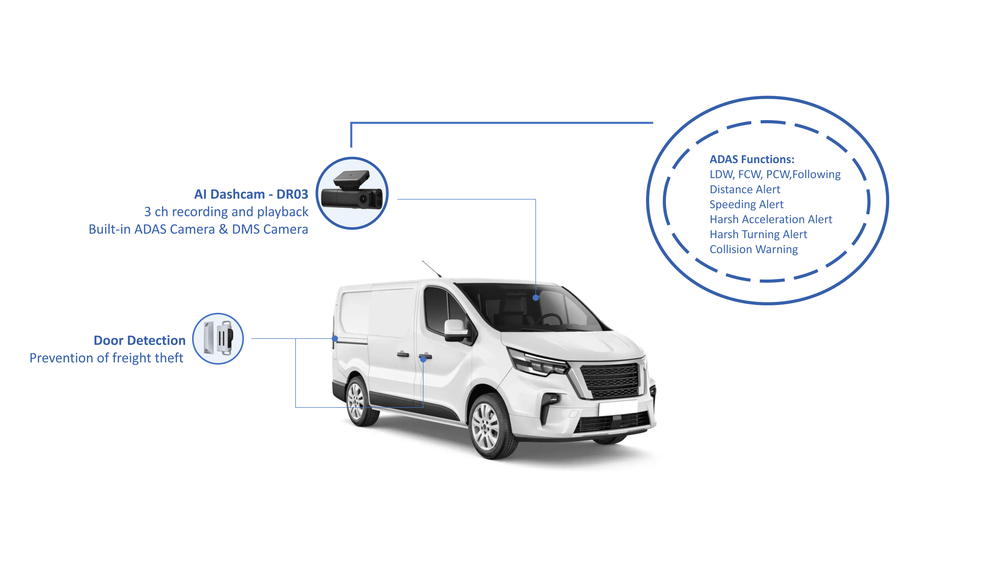
Facing the core problem
Fleet managers often wrestle with one hard question: where to spend limited budget to reduce crashes, cut operating cost, and keep drivers accountable. The choice isn’t academic — it’s operational. Many fleets consider adding camera-based systems alongside their GPS and engine-telemetry stack; some go straight to an AI MDVR to get both video and smart analytics. I’ve advised mixed fleets and integrators and I’ve seen the same scene: operators want clearer decisions from their data, not more noise. A municipal bus fleet in London that added targeted video analytics reduced incident review time dramatically, which shows how hardware plus smart processing can change workflows.
What fundamentally separates the two approaches
Think of conventional fleet telematics as a stream of state data (location, speed, fuel, engine codes) and AI video telematics as visual context layered on top. Core differences: data type (telemetry vs. continuous or event-driven video); processing location (cloud-based aggregation vs. edge inference on the unit); bandwidth needs (low vs. high unless AI filters at the edge); and the kinds of outcomes you can trust (pattern alerts vs. visual evidence). When hardware matters, consider how the on-vehicle recorder fits your setup — a modern vehicle mdvr can do both continuous recording and run AI models locally so you don’t flood your network with raw footage.
Gains and trade-offs framed simply
There’s no free lunch. Expect these trade-offs: – Safety detection: AI video finds distracted driving and near-misses that telemetry alone can’t; – Evidence and compliance: video proves what telemetry suggests; – Cost: cameras and storage raise upfront spend and ops overhead; – Privacy and policy: video needs clear retention and consent rules; – False positives: poorly trained models create noise. Choose to pay for clearer cause (video) when you need root-cause and driver coaching. Keep telemetry when you need scale and a cheaper baseline for routing and maintenance.
Avoid these common mistakes
Operators often do one of three things that reduce value. First, they treat video as optional evidence and never integrate it into workflows — reviews remain ad hoc. Second, they ignore edge processing and drown in uploads. Third, they skip calibrating models for their vehicle types and duty cycles, so alerts don’t match reality. Fixes that actually work: plan how alerts become actions; prefer edge inference to limit bandwidth; validate AI models on your routes and drivers; set realistic retention windows tied to policy and storage budget.
Practical checklist to choose the right system
Use this quick checklist when evaluating vendors: 1) Does the system fuse video and telemetry so alerts show cause; 2) Can the device run models at the edge to limit data transfer; 3) How easily does it export evidence for safety reviews; 4) What are retention and privacy controls; 5) Are update and model retraining processes transparent; 6) Can the vendor show operator deployments similar to yours. Answer plainly — tools that complicate workflows are the wrong tools.
Final synthesis
Decide by the problem you need solved. If you must prove incidents, coach drivers with visual feedback, or detect behaviors telemetry misses, prioritize a camera-first approach with strong edge capabilities. If you mainly need routing, fuel data, and high-level maintenance triggers, a telematics-first stack stays efficient. Either path works when deployment focuses on integration, model fit, and clear review processes. My experience says the real value comes when teams treat the system as operational infrastructure rather than a report generator — and that practical pairing of hardware, software, and process is exactly what I see delivered by BSJ.