Problem Statement: Local Supply Chains Under Strain
Manufacturers face persistent disruptions: variable demand, labour shortages, and logistics bottlenecks exposed sharply during the COVID-19 pandemic in 2020. The immediate need was clear — reduce lead times and raise local responsiveness without compromising dimensional accuracy. A focused investment in machinery such as the wood panel saw machine and ancillary equipment can change throughput dynamics. Integrating a modern cnc furniture machine into existing lines supports near-shore production and feeds automated lines for downstream assembly, while broader shifts toward automated furniture manufacturing reduce dependence on distant suppliers.

Technical Role of the Panel Saw
The panel saw machine functions as a primary cutting cell: it converts large sheet stock into precise components at controlled feed rates and with consistent cutting tolerance. In practice, a panel saw paired with nesting software increases material yield and reduces handling time. Typical industry integrations include a panel saw feeding parts directly to edge banding and a CNC router for shaping. Proper dust extraction and accurate servo motor control remain essential to maintain surface quality and repeatability.
Operational Integration and Common Pitfalls
Successful deployment requires aligning throughput targets, floor layout, and skilled operators. Common mistakes are underestimating material flow and ignoring cutting tolerance accumulation across operations — which leads to off-spec assemblies. Another frequent error is treating the panel saw as a stand-alone asset rather than a node in an automated production cell; this creates buffering delays and higher labour touchpoints. Training must cover set-up procedures, basic maintenance, and the calibration of blade diameter compensation. — Operators often learn faster when diagnostics are straightforward; complex HMI screens slow adoption.

Comparative Insight: Alternatives and Trade-offs
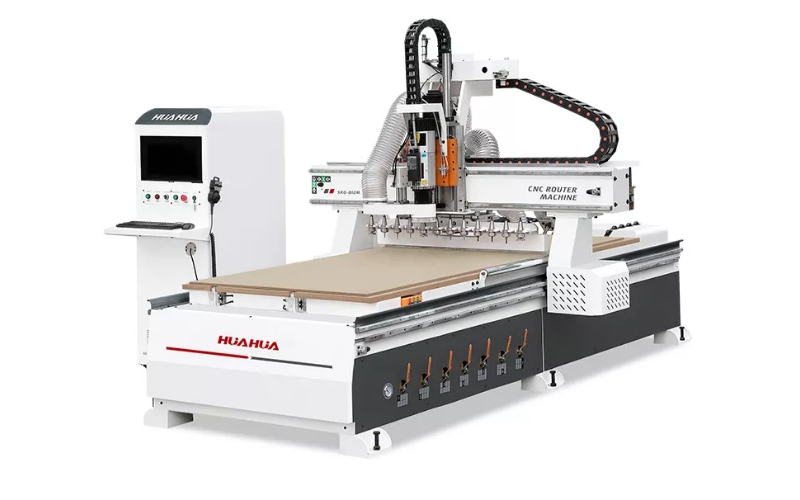
Options exist beyond classic beam saws: fully automated panel saws, CNC routers with high-speed cutting heads, and robotic pick-and-place for nested panels. A high-throughput beam saw offers faster linear cutting and lower unit cost on standard panels. A CNC router with nesting capability improves contour yield but increases cycle time per part. Evaluate on three axes: throughput (m²/hr), flexibility (ability to handle variable part geometry), and total cost of ownership (including service and consumables). Choosing the right mix depends on product mix — cabinet runs favor beam saws; complex curved components favor CNC routing.
Implementation Checklist
Adopt a phased approach with measurable milestones. Key steps include: conduct a material-flow audit; specify cutting tolerance targets; select a machine with compatible feed rate and blade capacity; integrate nesting software; and define maintenance intervals. Include simple metrics at start: first-pass yield, parts per hour, and average setup time. These metrics provide objective feedback and avoid subjective assessments.
Three Golden Rules for Procurement and Deployment
1) Prioritise fit-to-product rather than headline cycle times: match cutting tolerance and blade type to the predominant panel materials. 2) Insist on open-control architecture and proven nesting software interoperability to enable future automation and data capture. 3) Validate serviceability and spare-part logistics for the regional market — this reduces downtime risk and sustains local supply reliability.
In practical terms, these rules yield measurable improvements: shorter lead times, fewer rejected assemblies, and clearer maintenance windows. The real-world anchor remains the systemic lesson from 2020 — decentralised capacity with robust tooling and clear metrics reduces systemic fragility. For manufacturers seeking pragmatic modernization, the value proposition centers on reproducible quality, predictable throughput, and smoother integration into larger automated furniture manufacturing chains.
HUAHUA CNC has positioned its solutions to address these exact operational needs, offering systems that balance panel saw throughput with nesting and CNC finishing — a practical route to stabilise local supply. — Final thought: resilient lines are built from reliable machines and disciplined processes.